How to Choose a Home Blood Pressure Monitor
Compare upper-arm and wrist monitors, check cuff fit and separate useful features from extras. A practical buying checklist without brand rankings.

Published ·3.5 min read
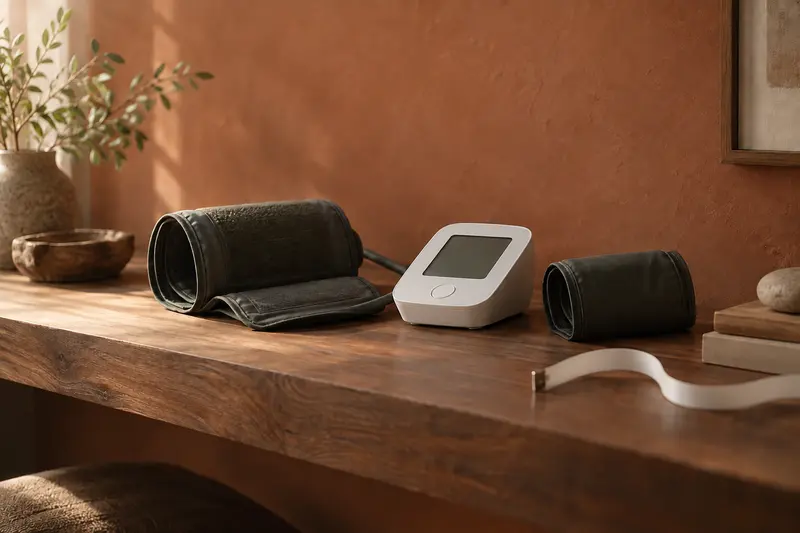
The useful question is not which monitor has the most features, but which device you can use correctly and bring into your care routine. This is a comparison of equipment types and buying criteria. Qerano has not bench-tested individual models and does not award a brand winner.
Start with the measurement method
The American Heart Association recommends a validated automatic upper-arm monitor rather than a wrist or finger device. [1] “Validated” is about accuracy assessment, not customer star ratings. Ask a pharmacist or clinician to help check the exact model in a recognized validated-device listing.
| Choice | What to establish before buying |
|---|---|
| Upper-arm monitor | Exact model, suitable cuff range and a usable seated setup |
| Wrist monitor | Whether your clinician recommends it for your circumstances and can check technique |
| Connected monitor | Whether you actually need its app and can export a usable record |
If no upper-arm cuff fits, discuss alternatives with your clinician rather than choosing a wrist model solely for its smaller size. Mayo Clinic describes circumstances where an alternative can be considered and checked in the clinic. [5]
Treat cuff fit as a buying requirement
Cuff mismatch can affect readings. [4] Measure your upper-arm circumference as the manufacturer's sizing instructions specify. Write it down, then compare it with the range for the cuff included in that exact package. A photograph of a large-looking cuff is not a size specification.
Ask whether another cuff is needed, whether it is compatible with that model and whether the total price still suits your budget. If sharing a device, check each person's fit separately. Check the return conditions before opening the packaging, particularly when fit is uncertain.
Compare the routine, not just the screen
A readable display, manageable buttons and an understandable manual matter more than an impressive feature list. Try to establish whether you can put on and remove the cuff yourself. If that is difficult, ask for a demonstration before committing.
Consider how you will record results. A paper log may suit one household; separate user memories may suit another. For an app, check account requirements, export format and whether core measurements remain usable without an active phone connection. These are questions to verify for the model, not features we assume every device has.
Count the whole purchase
Put the device, correctly sized cuff, batteries or power adapter, and any optional subscription on the same comparison sheet. Leave an unknown cost marked unknown. Check replacement-cuff availability and who handles support in your country.
Do not confuse a monitoring device with a diagnosis. Blood pressure testing can identify a problem even when there are no symptoms, but interpretation belongs in a healthcare conversation. [3] Our online care comparison can help you ask who will review the results and provide follow-up.
Plan the first session before checkout
Correct positioning remains necessary whatever the price: support the back and arm, keep feet flat and place the cuff on bare skin. [2] Read our step-by-step measurement and logging guide before the device arrives.
Is Bluetooth necessary?
Only if it makes your own record easier to keep and share. Ask the clinic what format it accepts first. An app that produces a report nobody uses adds little to that task.
Should a healthy man buy one automatically?
Discuss your reason for monitoring and access to a blood pressure check before buying. Ownership is not the same as a care plan. For a separate everyday habit project, use the walking guide and weight-management hub, without treating either as blood pressure treatment.
Sources
- American Heart Association. Home Blood Pressure Monitoring. Publication date not provided. Accessed: 2026-09-20.
- CDC. Measuring Your Blood Pressure. Published/updated: 2024-05-15. Accessed: 2026-09-20.
- NHS. Blood pressure test. Publication date not provided. Accessed: 2026-09-20.
- American Heart Association. Popular home blood pressure cuffs may not fit millions of adults. Published/updated: 2024-09-06. Accessed: 2026-09-20.
- Mayo Clinic. Get the most out of home blood pressure monitoring. Published/updated: 2026-01-21. Accessed: 2026-09-20.
Keep exploring
A little more perspective.
How to Measure Blood Pressure at Home
Prepare your monitor, sit correctly and keep a useful blood pressure log. Learn what to record, what to ask your clinician and when to seek help.
3.5 min read ↗
Best Online Men’s Health Services: How to Compare Care
Compare online care formats, clinician credentials, assessment, privacy and follow-up. A practical selection guide without invented provider rankings or prices.
4.5 min read ↗
Walking for Weight Loss: A Plan You Can Adapt
Build a walking routine around your starting point, schedule and recovery. A flexible plan for men, with realistic expectations about weight loss.
3.5 min read ↗