Haircuts for Men with Thinning Hair
Compare short cuts, crops and side parts for thinning hair. Prepare a clear barber brief and choose a style that fits your real daily routine.

Published ·4 min read
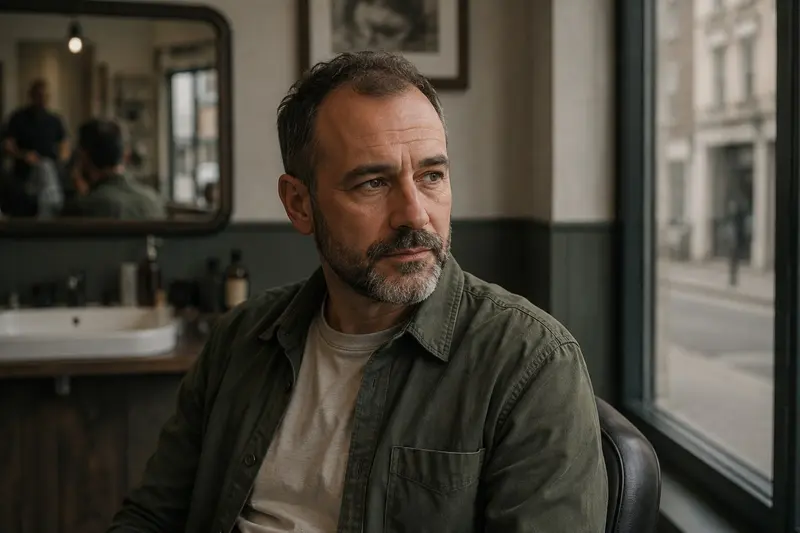
A haircut can make your daily routine simpler and give your hair a shape you enjoy. It cannot diagnose hair loss or restore missing hair. The useful question is which cut works with the hair you have today, in the light and conditions in which you actually live.
There is no obligation to hide a receding hairline. A deliberate short cut and a longer, softly styled cut are both valid choices. This guide helps you compare them and arrive at the barbershop with a clear brief.
Start with your current hair, not a reference model
Look at your hair when it is dry and arranged as you normally wear it. Notice the front, temples, crown and sides. A photograph taken from behind can help you explain an area you cannot easily see in a mirror. Use it for the haircut conversation, not as a medical assessment.
Choose reference photographs with a broadly similar hairline, texture and amount of hair. Tell your barber what you like about each picture: the short sides, the relaxed fringe or the absence of a hard part. A reference is a starting point, not a promise that your result will look identical.
Compare three directions
Wahl's styling guide describes side-parted, buzz-cut and closely cropped approaches to balding hair. Those are styling options, not evidence that a haircut treats hair loss. The trade-offs below are Qerano's practical editorial framework. [1]
A short, even cut
A buzz cut gives you a straightforward overall shape. It also leaves your scalp and hairline visible; choose it because you like that appearance, rather than expecting complete concealment. If you are uncertain, ask for a longer starting length and assess it before going shorter.
Ask how the cut will be maintained between appointments. Do not assume an attachment number means the same length on every clipper. Have the barber record the actual length and the areas where it was used.
A short crop with a soft front
A crop keeps some length on top and can be worn forward or loosely to the side. Ask the barber to demonstrate it using your own hair. Decide whether you like the result without elaborate styling, and whether the front still looks intentional when it moves.
Avoid committing to a fringe solely because it covers an area in a carefully arranged photograph. Your useful test is whether you are comfortable wearing it during an ordinary day.
A longer top with a gentle side part
Keeping more length may suit someone who enjoys combing and arranging their hair. Ask for a soft transition into the sides and discuss where the part naturally sits. Check the top from more than one angle before deciding how much length to keep.
This option gives you more styling decisions each morning. If you dislike those decisions, a shorter shape may fit your routine better even if you initially prefer the longer reference photograph.
Give the barber a usable brief
Try: “I want a shape that works with my present hairline. Please leave enough length to show me a relaxed crop first. I want to style it with a comb, and I would rather keep the sides soft than have a very sharp contrast.”
Add your own priorities: how often you want appointments, whether you wear a hat, and how much styling you genuinely do. Ask the barber to show the back and crown before the appointment ends. Save a photograph of a result you like for next time.
Test the routine before buying products
Ask to see the cut arranged with a comb before adding a styling product. If a product is used, ask what appearance it is intended to create and how much was applied. You can then decide whether that step belongs in your routine.
Do not buy a full range simply because it appears beside the mirror. A product that changes finish or hold is not automatically a treatment for thinning hair. Keep those buying decisions separate.
Keep styling and hair-loss assessment separate
This is a haircut guide, not a diagnosis or treatment plan. If understanding the loss itself is your priority, read our guide to why men lose hair and discuss your concerns with an appropriate clinician. A barber can help with shape; that conversation does not replace a medical assessment.
Further reading
Sources
- Wahl. How to Cut Balding Hair. Publication date not provided. Accessed: 2026-09-07.
Keep exploring
A little more perspective.
How to Trim a Beard at Home
Maintain a beard at home with a conservative approach to length and contours. Learn what to prepare, when to stop and how to follow your trimmer manual.
4 min read ↗
Men’s Grooming Kit Essentials
Build a practical grooming kit around your beard and hair routine. Compare useful attachments, cleaning requirements and full purchase costs before buying.
4 min read ↗
Why Men Lose Hair and What Can Be Done
Understand the possible causes before choosing your next step.
2 min read ↗