Resistance Bands vs Dumbbells for Home Workouts
Compare storage, setup, progression and purchase checks for resistance bands and dumbbells. Choose equipment around your home routine, not a universal winner.

Published ·3.5 min read
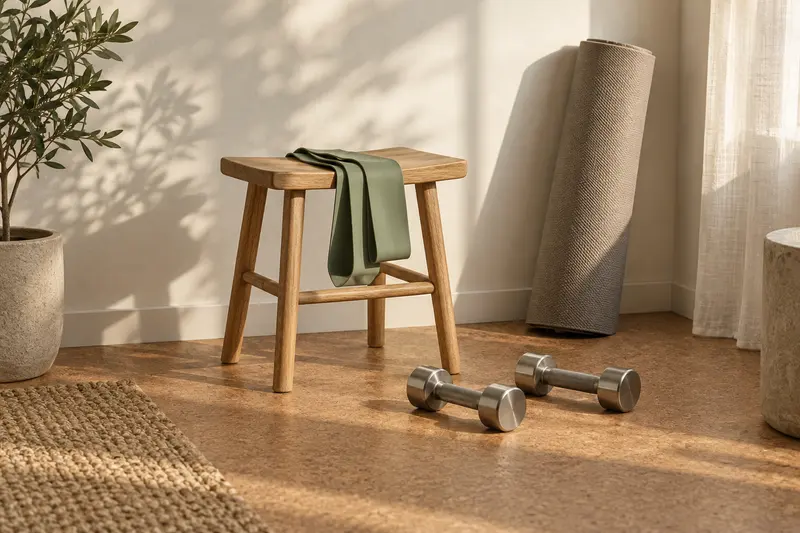
Resistance bands suit a small bag; dumbbells suit someone who prefers selecting a stated weight. That is a useful starting distinction, not a verdict on which will produce a better body. NHS guidance includes both bands and weights as muscle-strengthening activities. [4]
This is a practical equipment comparison, not a laboratory test or a ranking of brands. Start with the exercises you intend to learn, the space you have and the setup you will repeat. If you have health concerns or have not exercised for some time, ask a clinician about an appropriate starting routine. [3]
Compare the practical trade-offs
| Decision | Resistance bands | Dumbbells |
|---|---|---|
| Storage | Usually fit in a small drawer or bag | Need a secure place for the weights |
| Setup | Some exercises require a suitable anchor | Need room to pick up, move and set down weights |
| Recording sessions | Note the band and how it was positioned | Note the stated weight used |
| Changing the challenge | Choose a suitable band or setup according to instructions | Select another weight or adjust the model |
| Before buying | Check material, condition and approved attachments | Check grip, locking mechanism and available increments |
These are purchasing considerations. Band colour is not a universal unit across brands, and a headline resistance figure should not be treated as interchangeable with a dumbbell of that labelled weight.
To keep those equipment differences visible between sessions, use consistent exercise and load labels in a training log. The record should identify the band setup or weight convention, rather than assuming equal resistance from similar numbers.
When bands fit the routine
Consider bands if portability is your main constraint and you are willing to learn each setup. Before buying a set, find out which exercises require an attachment, whether the manufacturer supplies it and where it can safely be used. An ordinary door or piece of furniture is not automatically an approved anchor.
Read the material information if you need to avoid latex. Follow the manufacturer's inspection and replacement instructions. A damaged band is not made suitable by choosing an easier exercise. Store equipment where children or pets cannot play with it.
When dumbbells fit the routine
Consider dumbbells if you prefer a clearly labelled weight and have somewhere to use and store them. Fixed pairs avoid an adjustment step but additional weights occupy more space. Adjustable models change that storage calculation while adding a mechanism you need to understand.
Try to establish the smallest available weight change, grip dimensions and how the locking system is checked. Think about the full movement area, including putting the weights down, rather than only the storage footprint. Do not buy a heavier set simply because its maximum looks better value.
Learn the movement before increasing the load
Use controlled technique and a manageable load; breathe during the movement and stop if an exercise causes pain. Ask a qualified instructor to check unfamiliar movements. [5] Neither a colour-coded band set nor a collection of weights supplies instruction by itself.
For nutrition questions alongside a training routine, see our protein guide. If choosing digital instruction, the fitness-app comparison offers a separate checklist for coaching and program fit.
Keep the rest of the week in view
NHS guidance suggests building up walking gradually if you are inactive. [1] Our walking plan can help organize that part of your week. For weight management, activity and eating patterns both matter; no piece of equipment guarantees weight loss. [2] See the broader weight-management hub before treating an equipment purchase as a complete plan.
Do you need both?
No purchase combination is obligatory. Start with what suits your planned exercises and available space, or get instruction before buying either. Add the second option when you can name the specific task it would solve. “I might need it later” is a weak reason to fill a room today.
Sources
- NHS. Walking for health. Publication date not provided. Accessed: 2026-09-20.
- CDC. Physical Activity and Your Weight and Health. Published/updated: 2026-04-07. Accessed: 2026-09-20.
- NHS. Physical activity guidelines for adults aged 19 to 64. Publication date not provided. Accessed: 2026-09-20.
- NHS. How to improve your strength and flexibility. Publication date not provided. Accessed: 2026-09-20.
- Mayo Clinic. Weight training: Do's and don'ts of proper technique. Published/updated: 2026-01-21. Accessed: 2026-09-20.
Keep exploring
A little more perspective.
Walking for Weight Loss: A Plan You Can Adapt
Build a walking routine around your starting point, schedule and recovery. A flexible plan for men, with realistic expectations about weight loss.
3.5 min read ↗
How Much Protein Do Men Really Need?
A practical look at protein, everyday meals, and your individual needs.
2 min read ↗
Best Fitness Apps for Men in 2026: 6 Options Compared
Which fitness apps are actually worth using? Compare Strong, Hevy, Fitbod, Nike Training Club, Ladder and Strava by goals, free features and limitations.
12.5 min read ↗